
Reproductive Endocrinologist
& Infertility Specialist

Serving the Baltimore–Columbia–Washington, DC region
Evidence-based, pragmatic fertility care to help patients understand the science, weigh their options, and choose a path they can stand behind.
Fertility care is rarely one-size-fits-all.
Patients with the same diagnosis may have very different goals, timelines, and personal values, and what feels like the right next step for one person may not be right for another.
Dr. Cameron believes patients make the best decisions when they have clear information, realistic expectations, and a trusted physician to help them navigate uncertainty. Her approach pairs scientific rigor with honest communication and individualized decision-making. She helps patients understand their biology, think through their options, and choose a path that feels right for their lives and families.
"When your own body won't cooperate, it can feel like a betrayal. So much of my job is handing some of that control back."
CREDENTIALS
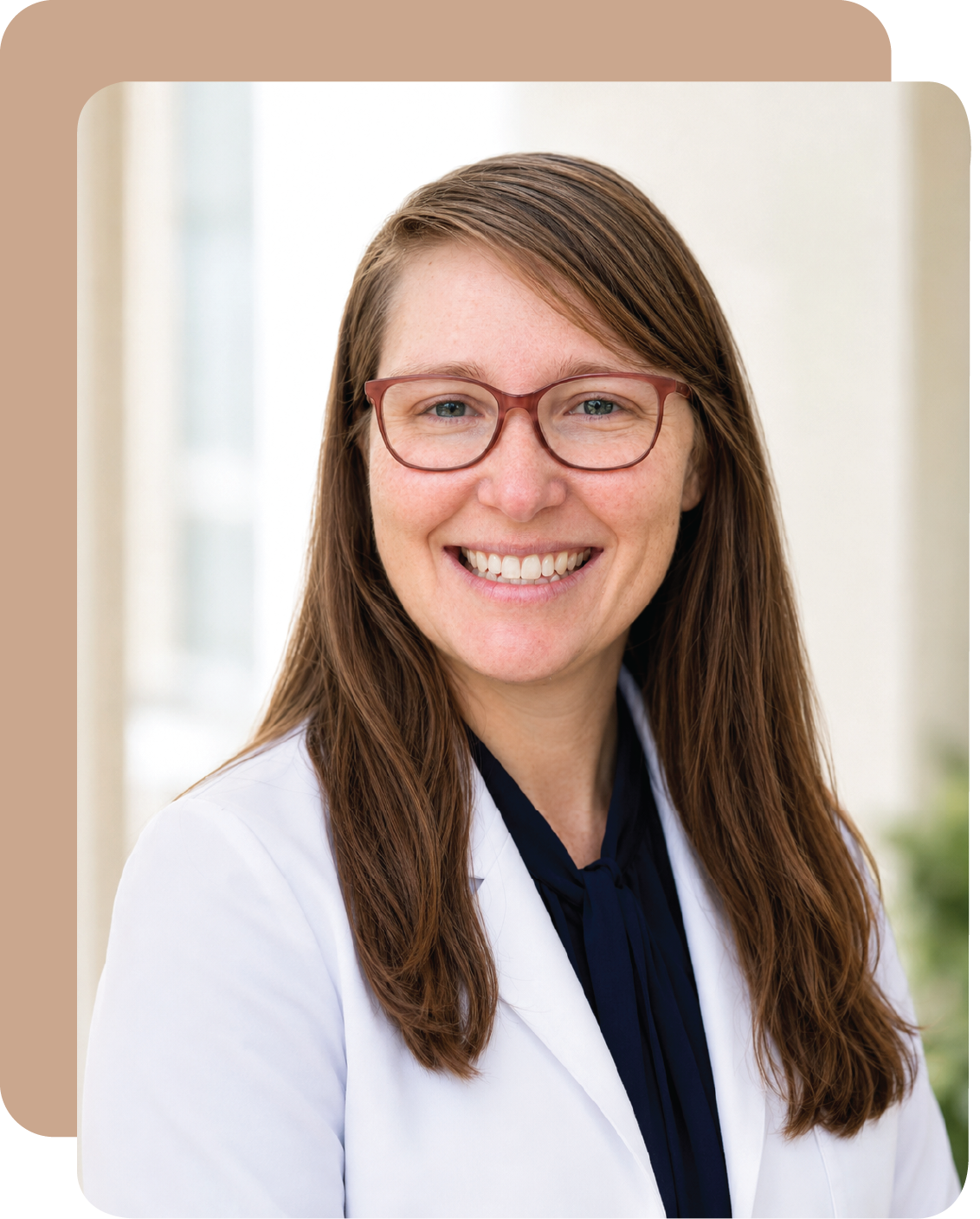
Katie Cameron, MD, MSCE, MBE
Reproductive Endocrinologist & Infertility Specialist
Board-certified, Obstetrics & Gynecology
Board-certified, Reproductive Endocrinology & Infertility
Master of Bioethics, University of Pennsylvania
Master of Clinical Epidemiology, University of Pennsylvania
Chair-Elect, ASRM Ethics Committee
Member, SART Quality Assurance Committee
Questions
and Answers
-
If your cycles are irregular, you're unsure whether you're ovulating, or fertility preservation is on your mind, it's worth a conversation now. If you've been trying to conceive without success, the general guidance is about a year — or six months if you're over 35. A reproductive endocrinologist can clarify what may be affecting your fertility, explain your options, and help you decide when evaluation or treatment makes sense.
-
This is one of the most common and most important misunderstandings, partly because of how IVF is portrayed in popular culture. IVF is a powerful tool, but when you're using your own eggs, it does not fully overcome the biological effects of age. Success in IVF hinges on two things: how many eggs can be retrieved (egg supply) and what proportion of them will create chromosomally normal embryos when fertilized (egg quality). Beginning around age 35, the proportion of good-quality eggs starts to decline, and IVF can't reverse that — it can only work with the eggs that are there. None of this means IVF won't help; it means honest expectation-setting matters, and the realistic picture is different for every individual.
-
If it's crossed your mind, it's worth a conversation — because the right answer is genuinely individual. Earlier is generally better: the proportion of good-quality eggs begins to decline around age 35, so freezing before then tends to be more favorable. At the same time, the likelihood you'll ever actually need frozen eggs is its own question, and some data point to an inflection around the late 30s — which is worth understanding so the decision fits your real reproductive goals and timeline. Dr. Cameron is honest with patients that egg freezing is, in a sense, an insurance policy with terms you probably wouldn't agree to in any other context: you don't find out how good your inventory is until the moment you need to use it, and by then you may not be able to add more. That's not a reason to avoid it — it's a reason to go in with a clear, realistic picture.
SPOTLIGHT ON:
Fertility Preservation & Oncofertility
Fertility preservation is one of Dr. Cameron's distinctive areas of expertise — counseling people facing a new cancer diagnosis, those preparing for treatment that may affect fertility, and survivors looking ahead to building a family after treatment.
The most important shift in how this care is delivered is that the conversation is no longer a single moment before treatment — it's a continuum. The 2025 ASCO guideline update formally recognized this, recommending fertility discussions not only at diagnosis and before therapy, but throughout survivorship as well.